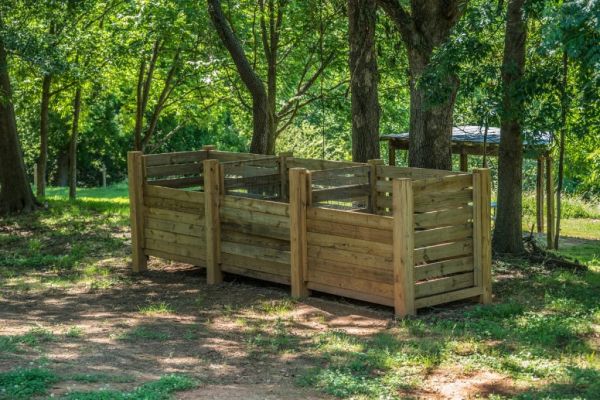
The Three-Bin Composting System is suitable for a large amount of garden waste and food waste. This method allows for hot composting of waste and requires active management, including turning for aeration. Bins are arranged side by side for easy turning from one bin to the next where each compartment contains compost in different stages of maturation. This method of composting makes turning compost more convenient and easier to monitor the compost’s water level. A three-bin composting method is ideal if:
- You have a lot of organic waste
- You have enough space in your yard
- You want to store compost while it matures
- You are looking for a place to keep dry leaves for a constant supply of brown organic waste to balance with your green organic waste
- You want to produce high volume of compost quickly
- You are keen to have a thorough, convenient, and neater way to turn your compost than mixing everything with a garden fork or shovel.
How to do it
- When choosing your site, make sure you select a warm sheltered spot that protects the compost from wind and access moisture. Consider neighbors by placing the bin away from their house.
- Ensure, your compost heap should be at least 1m high x 1m wide x 1m deep or whatever size you want depending on the amount of waste you have.
- Add a layer of coarsely chopped twiggy woody material on bare soil or grass.
- Add alternate layers of green matter (nitrogen rich) and brown matter (carbon rich) preferably in layers no more than 5-10cm deep.
- Add compost materials (brown and green) to bin A until it is full.
- Turn all contents in bin A into bin B.
- Refill bin A while bin B’s Contents mature.
- When bin A is full again, turn bin B into bin C. Then turn bin A into bin B.
- Refill bin A. By the time bin A is full again, the compost in bin C should be matured, and bin B should be halfway there.
- Empty bin C using the mature compost.
- Continue the cycle by moving bin B to bin C and then bin A to bin B.
Tips
- Sprinkling on lime and untreated wood wash can help balance pH and reduce smells.
- The heap should be as moist as a wrung‑out sponge. Add water if necessary.
- For effective composting, the heap should reach temperatures between 30 and 60 °C. Periodically check that the center is warming; it should feel noticeably warm to the touch.
- Compost is ready when it becomes dark, crumbly material, and you cannot distinguish the original materials in it.
- Avoid cat/dog/human faeces, meat, fish, bones, oil and invasive weeds.
- Smaller pieces make quicker compost – therefore, fibrous materials should be no bigger than the thickness of your finger (2cm).
- The heap should have a cover, e.g. plastic lid, underfelt, tarpaulin.
- Rodents can be kept out by cutting out a piece of chicken wire larger than the bin base. Place it underneath the bin on the soil and fold the edges 10cm up the sides of the bin.
See the video on how to design a three-bin compost.
 ENM on Facebook