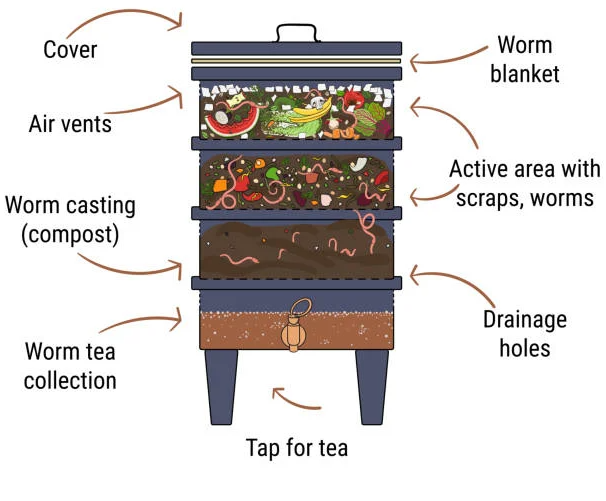
Compost can also be produced using worms, a process known as worm farming or vermiculture. This method uses an enclosed system in which worms consume food scraps, digest them, and produce nutrient‑rich worm compost that improves soil health.
In New Zealand, tiger worms are most used for worm farming, although red worms are also suitable. Worm farming follows the same principles as composting, but because it does not generate heat, it is considered a form of cold composting. As the worms consume and break down organic material, they produce vermicast and worm tea that contains nutrients that support strong leaf growth, robust roots and stems, and healthy flower and fruit development.
If you have mostly kitchen waste and live in a home with little or no outdoor space, a worm farm is a good option. Casts and worm tea are excellent for plants that must be diluted to the color of weak tea—typically about a 1:10 ratio before applying to the plant.
How to do it
- Choose a site that is sheltered from sun, wind, and rain.
- For this setup, use the bin or tray method, which is ideal for homes, balconies, garages, or small outdoor spaces.
- Earthworms need bedding that holds moisture and provides a suitable habitat. Add shredded paper or cardboard, straw, and partially decomposed organic matter and add a small amount of water to provide moisture.
- Add 1,000-2,000 (250g -500g) worms.
- Place worms on top of the bedding. They will naturally burrow away from light.
- Remove the top layer, then lift off the bottom layer containing the cast. It’s ready once only a few worms remain.
- Remove worm tea from the bottom level. When using, dilute the color of weak tea, usually about 1:10.
- When one working layer is full, you can add another layer to your worm farm.
- Place the new layer on top of the old one, add fresh bedding (paper, straw, or manure), and then top it off with more food scraps.
- Add food only to the new layer. The worms will migrate slowly to the food layer.
- If your plastic bin has deep layers and you want to harvest the cast sooner, you can add a layer of chicken wire instead of another plastic layer.
Worm’s Feed
What you can and cannot add to your worm compost.
|
What worms like |
What worms don’t like |
|
Most fruit and vegetable scraps |
Spicy food, chilli, onion, garlic |
|
Coffee grounds and teabags |
Meat and milk products |
|
Aged horse manure |
Flour product |
|
Dirty paper |
Large amounts of cooked food |
|
Crushed eggshells |
Garden waste |
|
Vacuum cleaner dust |
Shiny paper |
|
Hair |
Citrus / very acidic food |
Common worm farm problems
Problems associated with worm farming and possible solutions for it.
|
Problem |
Cause |
Solution |
|
Rotting food |
Too much for population |
Feed less |
|
Fruit / vinegar flies around farm or small white bugs and worms |
Too acidic
|
Add lime to increase pH
|
|
Worms climbing up sides Worms very fat and pale |
Too wet
|
Add paper products and dry leaves, gently fork holes in the working layer. |
|
Ants
|
Too dry or acidic
|
Add water/lime If your worm farm is on legs, place each leg in a container of water to stop such pests from getting in. |
|
Food rotting and not eaten |
Too much food / wrong food /pieces too big |
Add less food, break into small pieces |
|
No worm tea |
Not enough water |
Add water |
Tips
- A home vermiculture bin should have adequate drainage holes for ventilation that ensure airflow and prevent anaerobic conditions. Keep the lid on to keep out pests and maintain moisture.
- Your bin should be shallow in depth, as worms prefer the upper layers of organic matter.
- Maintain a temperature range of 15–25°C and avoid extremes below 10°C or above 30°C, as worms slow down or may die outside these limits.
- Keep moisture levels between 60–80%, ensuring the bedding feels like a wrung-out sponge—too much moisture creates anaerobic conditions, while too little dehydrates the worms.
- Do not overfeed in the first 1–2 weeks—allow them to settle.
- Add dry leaves or torn up paper products if it is too wet – the working area should be as damp as a wrung-out sponge.
- Add food scraps regularly. Smaller pieces—no larger than 2 cm—are eaten more quickly and help prevent odors.
See the video for more information on worm farming.
 ENM on Facebook